Coffee Board of India Packaging Standards & Guidelines: How to Stay Compliant and Still Stand Out
Recent Posts
Share this article:
What do Indian coffee brands need to follow to stay compliant, credible, and competitive in the coffee market? The answer lies in understanding and adhering to the Coffee Board of India packaging guidelines. The standards are to ensure coffee meets global benchmarks through proper nurturing, testing, and certification, while empowering growers, exporters, and brands to confidently brew and share their own coffee story.
From boutique estate roasters to export-oriented brands, India’s coffee sector has evolved rapidly. Coffee is no longer treated as a commodity, but as a story to be experienced. At the center of this coffee evolution lies packaging, where there is the intersection of regulation, trust, sustainability, and branding. Understanding how to strongly adhere to the Coffee Board of India packaging guidelines while creating a shelf appeal is one of the biggest challenges for modern coffee brands.
This blog is a comprehensive guide to navigate the official packaging norms designed by the Coffee Board of India packaging guidelines, including regulatory framework, design strategies, and professional branding support to bridge the gap between compliance and commercial success of Indian coffee brands. We will also learn how Coffee Board packaging rules can help coffee brands ensure compliance, build credibility, and trust in both domestic and international markets.
Why Coffee Packaging Standards Matter in India?
India is known for its Arabica and Robusta varieties of coffee grown across Karnataka, Kerala, and Tamil Nadu. Indian coffee packaging standards are designed to protect consumers, ensure transparency, safeguard quality, consumer trust, and uphold Indian coffee in domestic and global coffee markets. Proper coffee packaging protects coffee from moisture, contamination, and tampering while preserving the freshness, aroma, and flavour of the coffee.
With packaging, consumers make informed choices through standardized labeling and material requirements, which assure the consumers of authenticity, origin, and safety in coffee consumption. Coffee packaging compliance for brands with these standards reduces legal risks, supports export readiness, and strengthens credibility. Such standards markIndian coffee as a reliable, high-quality product that confidently sustains on the world stage.
Consumer trust through compliance

For consumers, packaging is the first interaction with a brand before purchasing a product. That’s why the packaging needs to give clear information, transparent identification, ingredients and composition, manufacturing information, barcodes, certification, etc. Consumers today are more informed; they look for:
- Proper labeling
- Transparent origin details
- Certified food safety information
And this compliant information builds confidence for both brands and consumers. When a coffee brand clearly displays accurate information, regulation-approved details, and safety standards, it reassures consumers that the product is authentic, safe, and ethically produced. This shared trust between brands and consumers strengthens brand loyalty over time, signals professionalism and accountability, reduces uncertainty, and helps buyers make informed decisions, along with long-term consumer confidence.
Coffee Board’s role in packaging oversight
The Coffee Board of India was established during the British colonial era in 1942 under the Coffee Act VII of 1942. Now it is a statutory body under the Ministry of Commerce and Industry, Government of India. The Coffee Board of India packaging guidelines and advisories play a significant role in regulating, safeguarding, and promoting Indian coffee. The Coffee Board of India packaging guidelines monitors and manages every coffee value. The Coffee Board of India packaging guidelines shape how coffee should be presented to the domestic and international markets.
These standards include:
- Maintain product quality
- Prevent adulteration
- Ensure traceability
- Align Indian coffee with global trade requirements
Understanding the Coffee Board of India packaging guidelines is essential for any coffee brand in India, because it signifies strong professionalism and reliability, making it easier to win consumer confidence in premium and export markets.
Coffee Board of India packaging guidelines
The Coffee Board of India packaging guidelines are important to define standards of quality, safety, transparency, authenticity, and global acceptability. These guidelines indicate the freshness, aroma, and shelf life of the coffee quality. The Coffee Board of India packaging guidelines help keep coffee brands free from contamination, moisture, and adulteration.
These packaging guidelines require proper labelling of details like coffee origin, net weight, batch, date of manufacture, and mandatory FSSAI compliance for domestic sales. And for exporters, the Coffee Board of India packaging guidelines extend to export-specific norms, barcodes, traceability, quality certification, and compliance with importing country regulations, so that coffee brands can compete confidently in both domestic and global markets. Coffee packaging compliance is about avoiding penalties, and most importantly, protecting the reputation of Indian coffee for any coffee brand from India.
- Labeling requirements (origin, variety, weight, batch, FSSAI):
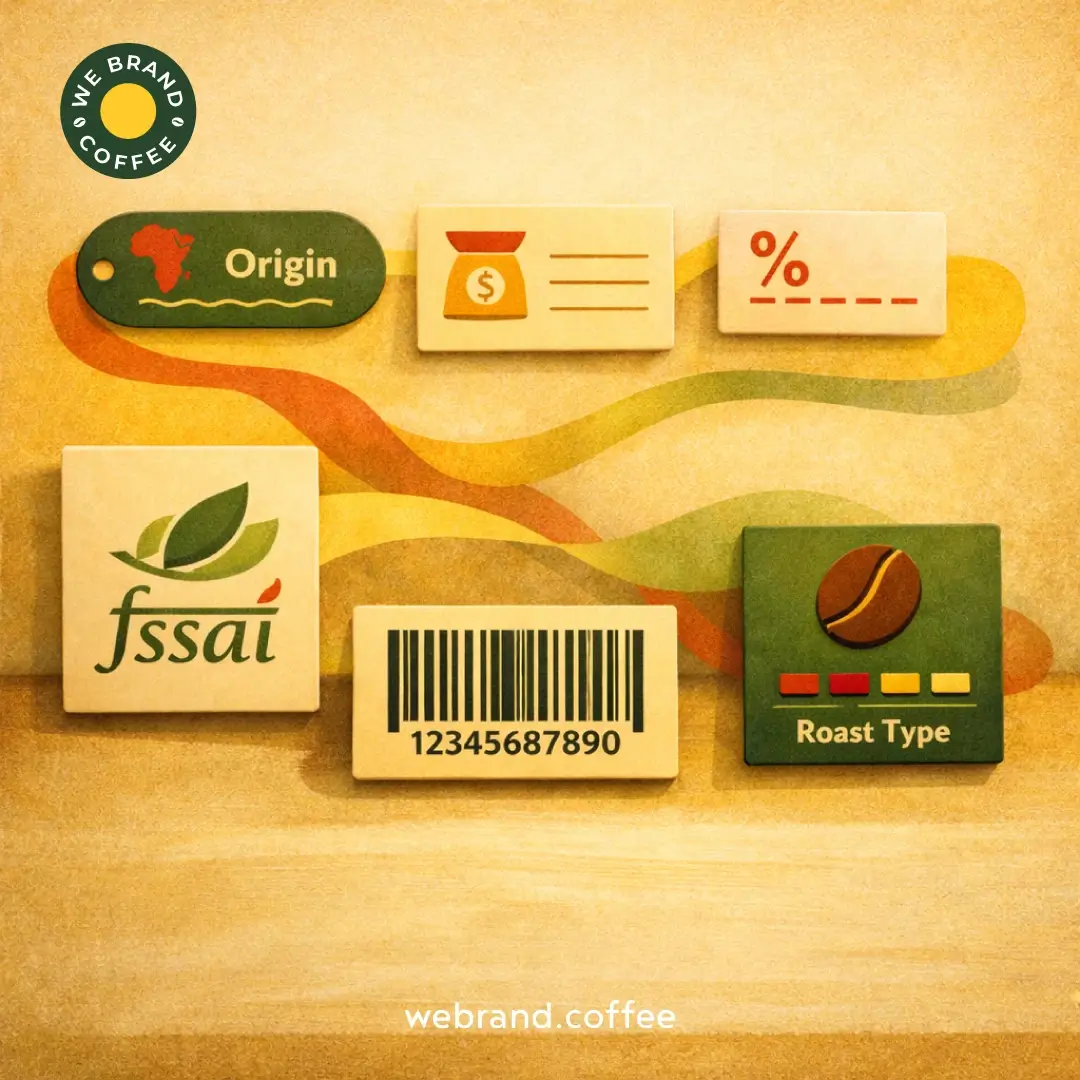
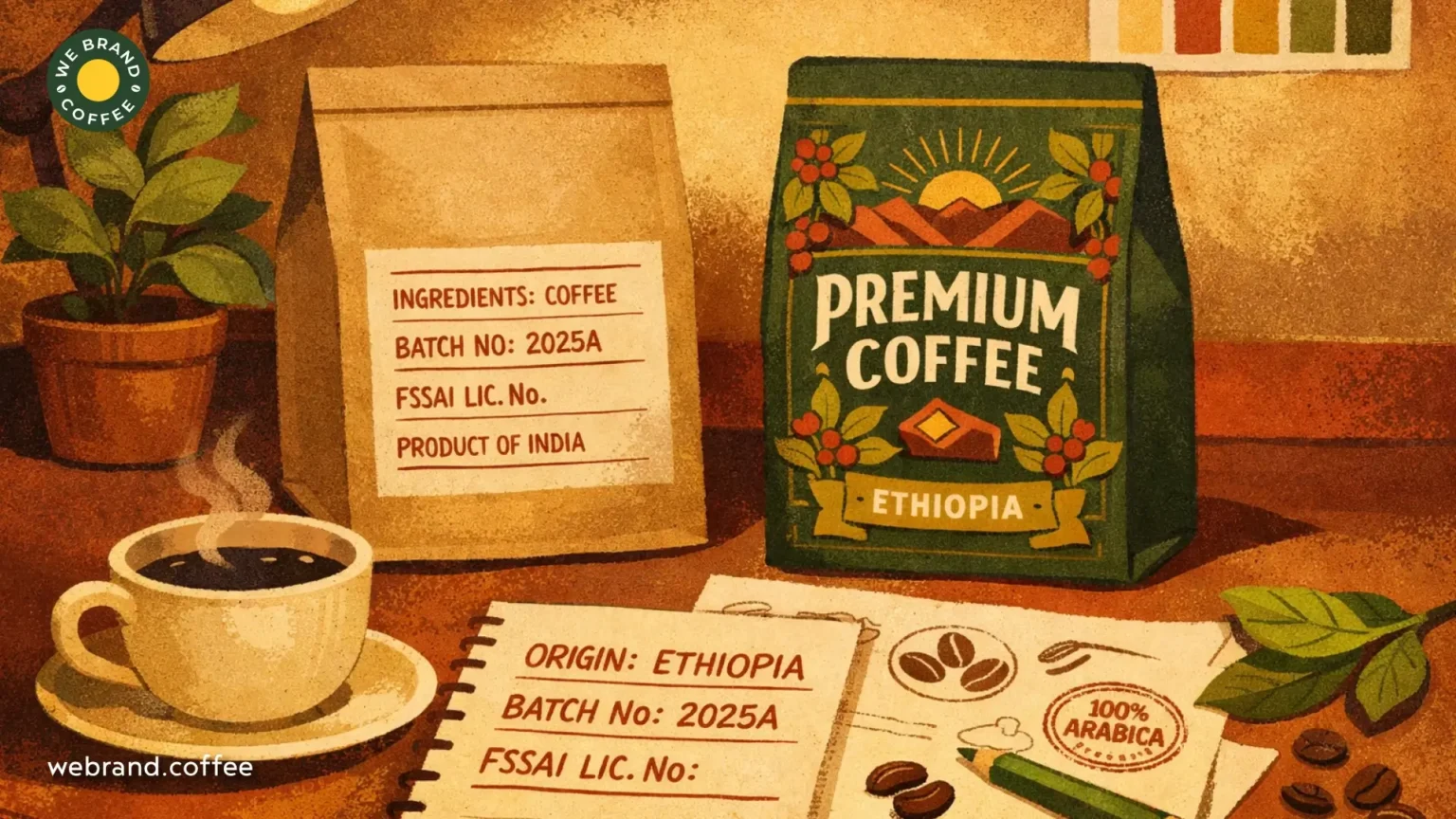
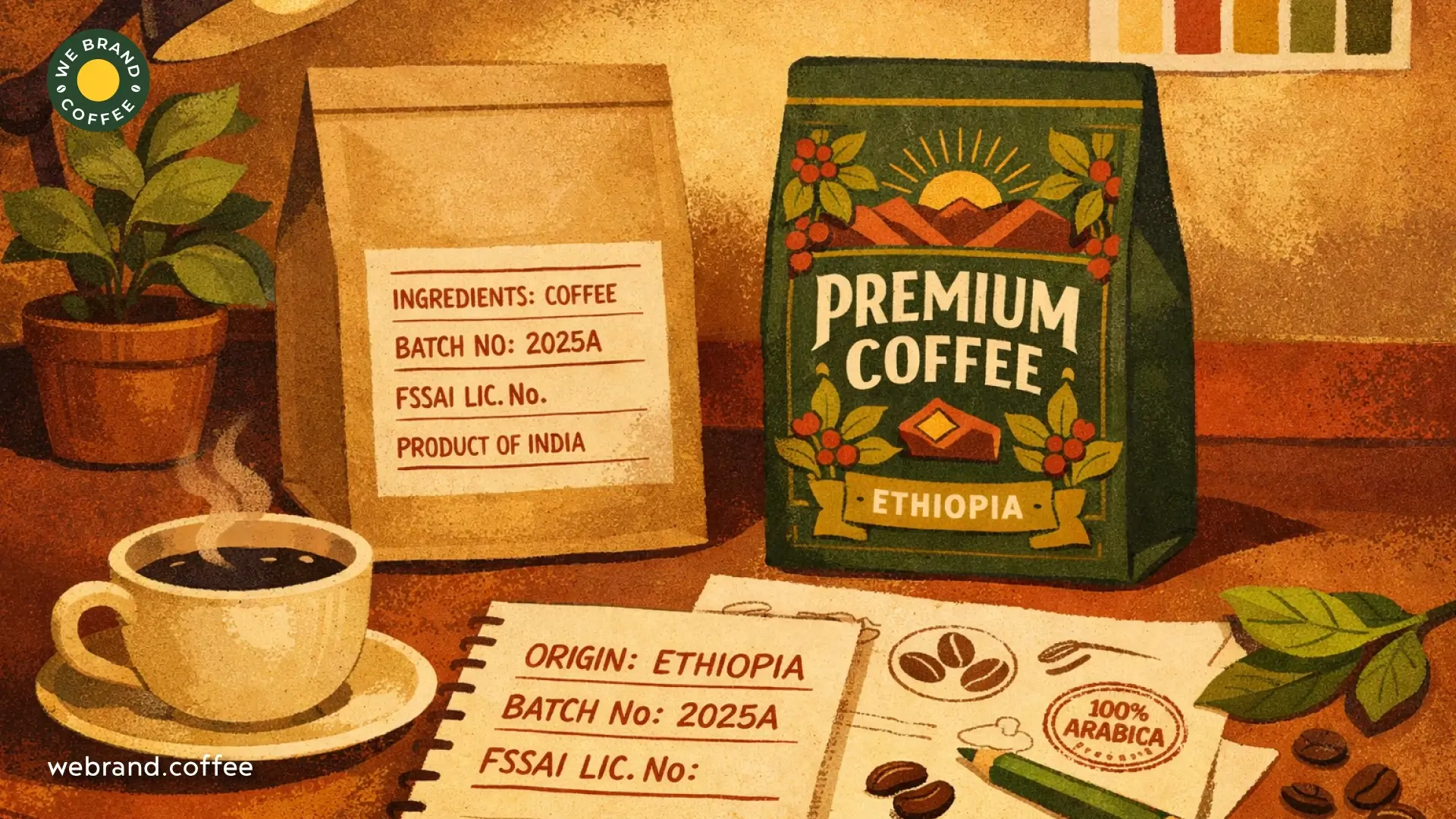
In the Coffee Board of India packaging guidelines, labelling plays a pivotal role, as it serves as the bridge between the coffee brand and the consumer, ensuring transparency, traceability, and trust. It is a crucial aspect of coffee packaging compliance that every branded coffee sold in India or outside India must clearly display:
- Product name (Coffee / Roasted Coffee / Instant Coffee)
- Country and region of origin
- Coffee variety (Arabica, Robusta, blend, etc.)
- Net weight
- Batch or lot number
- Date of manufacture and best-before date
- FSSAI license number
- Name and address of manufacturer/packer
Coffee branding agencies should incorporate these elements designed by coffee board of India packaging guidelines in the labelling of all coffee brands without compromising aesthetics or visuals.
Material and sustainability rules
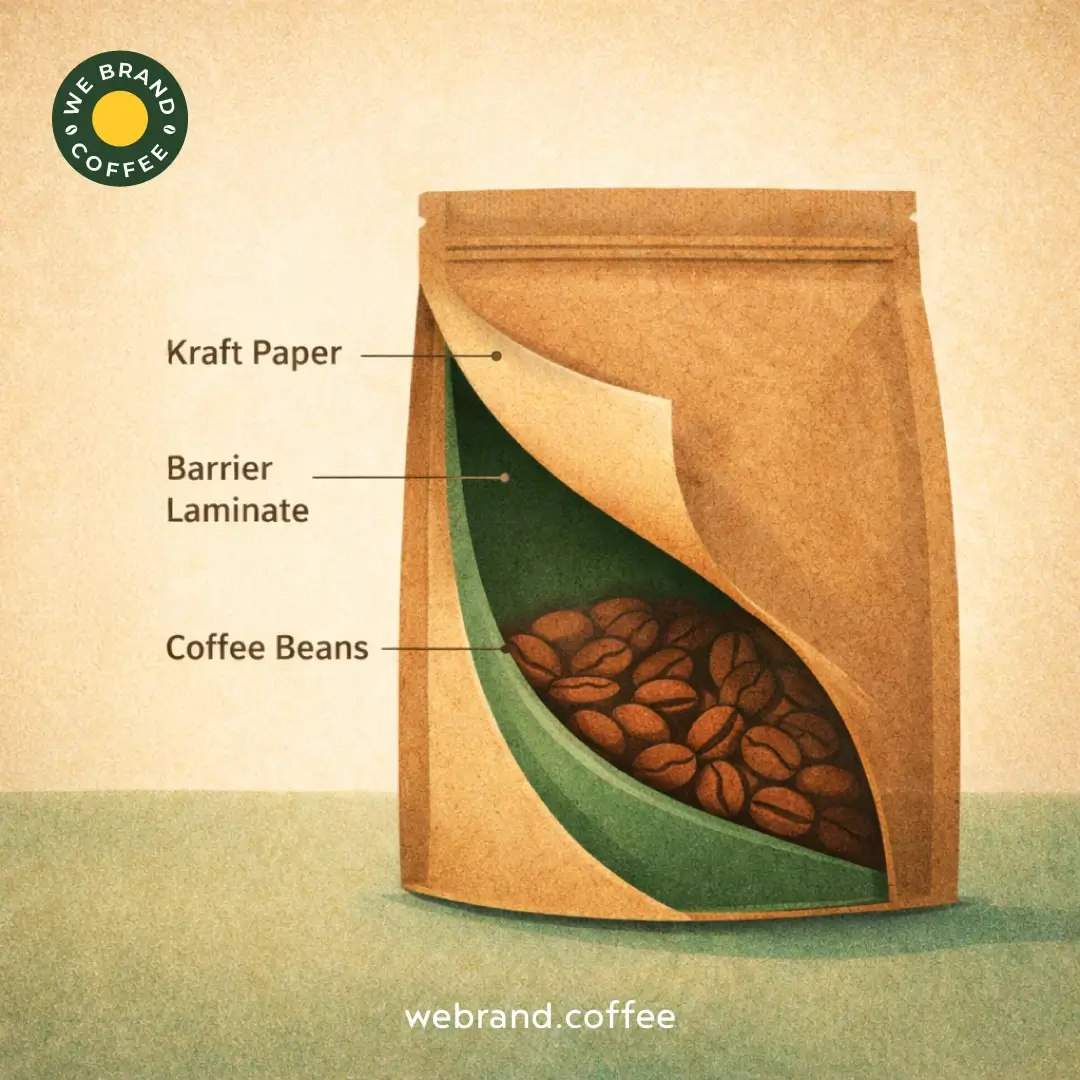
The Coffee Board of India packaging guidelines focus on material quality and sustainability to protect coffee quality while minimizing environmental impact. Coffee Board of India packaging guidelines emphasize in using materials that:
- Protect coffee freshness
- Prevent moisture and oxygen exposure
- Comply with food-grade safety standards
And the coffee board of India packaging guidelines encouraged to adopt:
- Recyclable laminates
- Kraft paper with inner barriers
- Mono-material packaging
By ensuring coffee packaging compliance through the use of approved and sustainable materials, brands protect product integrity, appeal to environmentally conscious consumers, and reinforce their commitment to responsible and ethical coffee production.
Export-specific packaging needs

The Coffee Board of India packaging guidelines has designed export-specific packaging rules to ensure Indian coffee meets the quality, safety, and regulatory requirements of international markets.
Export-specific packaging must comply with:
- Import country regulations
- International food safety standards
- Traceability norms
- Multilingual labeling
- Country-specific certifications
- Stronger protective materials
If any coffee brand fails to meet these export packaging requirements, the shipment will be rejected, and Indian coffee will lose its reputation in the global coffee trade.
The gap between compliance and market success
Coffee Board of India packaging guidelines design packaging compliance, ensuring legality, safety, and credibility of a coffee brand, while market success lies in how far coffee brands can go in meeting minimum regulatory requirements to create value for consumers.
Why is compliance packaging not equal to brand attractiveness?

Compliance packaging is not equal to attractiveness, because compliance is not designed to create emotional appeal or storytelling; rather, it is to ensure safety, accuracy, mandatory information, and legal and quality requirements. Compliance with the Coffee Board of India packaging guidelines ensures legality and safety, not emotional appeal or desirability. In today’s coffee market, coffee shelves are crowded with brands that meet the Coffee Board of India packaging guidelines, but a few couldn’t stand out. Reasons include:
- Generic packaging design
- Poor color choices
- Weak brand storytelling
Attractiveness in a brand comes from brand value, brand story, and aesthetics within the boundaries of compliance with the Coffee Board of India packaging guidelines. Without creative design and clear communication, even fully compliant packaging can appear generic, making it less attractive for customers to buy the product. So, both compliance and attractiveness play an important role to play while following the Coffee Board of India packaging guidelines.
- How do design choices influence buyer decisions?
Design plays a psychological role in first impressions and emotional connections for customers at the point of purchase decision. Most of the time, it is noticed that consumers judge a product based on packaging. In coffee packaging in India, successful coffee brands strictly follow the Coffee Board of India packaging guidelines that combine:
- Regulatory clarity
- Emotional storytelling
- Premium visual cues
The intersection of the Coffee Board of India packaging guidelines with coffee label design in India becomes critical to maintain. A clean, clear premium design often suggests superior quality of coffee, while earthy tones and textured materials communicate freshness, origin, and sustainability in terms of coffee. A thoughtful design captures attention, builds trust, and ultimately compels customers to purchase.
Designing coffee packaging that stands out
To stand out in coffee packaging, effective communication about quality, transparency, and authenticity is necessary, while striking a balance between compliance and creativity, and strictly follow Coffee Board of India packaging guidelines. Effective packaging relies on strong visuals, distinctive colors, and thoughtful typography to communicate the brand’s personality, origin, and roast profile. Materials and finishes enhance quality, while sustainable practice in packaging builds trust and reflects values.
- Creative logos, typography & storytelling: A well-designed logo creates instant recognition for customers. A thoughtful typography system ensures clarity, readability, and visual appeal. And, the role of storytelling in branding allows brands to highlight origin, craft, sustainability, or partnerships without any misleading. Storytelling in coffee packaging rules also helps transform compliance into brand value.
To understand the coffee board of India packaging guidelines, coffee brands can:
- Use bold brand marks
- Choose distinctive fonts
- Highlight origin stories
Creative logos, typography, and storytelling together play a vital role in differentiating coffee brands within the framework of the Coffee Board of India packaging guidelines.
- Color psychology for shelf impact: Color psychology within the framework of coffee board of India packaging guidelines plays a vital role in shelf impact. This helps coffee brands to capture attention and conversion in sales. Perceptions are instantly influenced by colours, creating clear visual differentiation on crowded shelves. This guides consumer expectations about flavor and quality, and strengthens the brand.
- Earthy tones → sustainability, origin & authenticity.
- Dark palettes → premium, richness & artisanal.
- Bright colors → youth & accessibility.
- Warm colours → boldness and intensity.
- Lighter or muted palettes → specialty, artisanal, or mild roast profiles.
Carefully curated colours with mandatory labeling and regulatory information to remain clear and compliant for the consumers. As per the Coffee Board of India packaging guidelines, the use of smart color palettes can enhance shelf visibility.
- Blending compliance with premium aesthetics: This means meeting regulatory requirements in coffee packaging while using design, materials, and finishes to create a refined brand presence by following the Coffee Board of India packaging guidelines. Compliance becomes part of the design when mandatory informations are integrated seamlessly into clean layouts, complemented by high-quality materials, thoughtful typography, and subtle finishes. Coffee brands with a premium visual design understand about balancing mandatory information as per the Coffee Board of India packaging guidelines with minimal design. This signals craftsmanship, trust, quality, and credibility to consumers.
Key strategies for blending compliance with premium aesthetics include:
- Clear hierarchy for compliance text
- Subtle icons for certifications
- Strategic placement of FSSAI and batch details
If a coffee brand can master balancing the two, compliance and aesthetics, following the Coffee Board of India packaging guidelines, it can provide coffee brands with a credibility badge.
How does We Brand Coffee help coffee brands with packaging?
We Brand Coffee provides a strategic blend of compliance, aesthetics, creativity, and market relevance in terms of packaging for coffee brands. We Brand Coffee, as a coffee branding agency, strictly adhere to the Coffee Board of India packaging guidelines to provide simple, clear, transparent, and brand-aligned solutions for all coffee brands. We Brand Coffee ensures that every package meets regulatory requirements designed by the Coffee Board of India packaging guidelines without compromising visuals. We work on accuracy and simplicity. In terms of labelling, material selection, premium design, export norms, sustainable practices in packaging, and protecting product integrity with a compelling brand story, We Brand Coffee never compromises. We work on that kind of coffee packaging which builds trust, remains transparent, stands out in the crowd, and supports long-term market success.
Experience in coffee branding & packaging:
WeBrandCoffee works exclusively with branding for coffee and beverages, with a deep understanding of the Coffee Board of India packaging guidelines, along with
- Regulatory expectations
- Consumer behavior in coffee markets
- Global design trends
- Print and material constraints
- FSSAI regulations
- Export labeling norms
We Brand Coffee is aware of different types of packaging designs that are relevant and creative to uphold the package and protect the coffee.
Case-Inspired Insights (Odissi Coffee, First Kaapi, etc.)
We Brand Coffee has completed several projects on coffee brands. We not only design packaging but also do website designing, handmade and creative logo designing, and digital marketing for coffee brands. A few of these coffee brands are Odissi Coffee, First Kaapi, La Bon, etc with thoughtful packaging:
- Respect regulatory frameworks
- Celebrate regional identity
- Appeal to modern consumers
- Support premium positioning
- Uses bold storytelling and cultural references
- Balances modern design with regulatory clarity
For We Brand Coffee, coffee packaging compliance does not mean sacrificing brand personality. Understanding the Coffee Board of India packaging guidelines, compliance is treated as a strategic framework, a foundation for ensuring clarity, credibility, and consumer confidence. Following the Coffee Board of India packaging guidelines, where every mandatory detail regarding coffee origin, batch information, and certifications is thoughtfully integrated. This allows the brand story to remain at the center, and compliance reinforces trust and accountability.
Conclusion: Compliance builds trust, branding wins customers
The Coffee Board of India packaging guidelines form the foundation for coffee quality, transparency, trust, and credibility, and compliance with these standards ensures legality, safety, and trust. This is where We Brand Coffee plays a significant role in bridging the Coffee Board of India packaging guidelines, regulations, and creativity to provide advantages to coffee brands. These guidelines are followed to protect product quality, integrity, stand out on crowded shelves, and achieve long-term success. We Brand Coffee aligns compliant labeling, sustainable materials, and premium aesthetics for coffee brands. This helps the coffee brands confidently share their coffee story with both Indian and global consumers.
Coffee Board of India packaging guidelines provide a framework for coffee brands, but strong branding is what turns compliance into conversion, drives consumer action, and sales. Following the Coffee Board of India packaging guidelines, thoughtful coffee label design, and partnering with an expert coffee packaging design agency, any coffee brand can ensure coffee packaging that is compliant and unforgettable. The most successful coffee brands are those that excel at both compliance and branding while respecting the Coffee Board of India packaging guidelines.
We Brand Coffee, as a coffee packaging design agency, help coffee brands understand the Coffee Board of India packaging guidelines, to express their heritage, values, and coffee quality by blending regulatory precision and mandatory requirements, with appealing visuals, without compromising on the Coffee Board of India packaging guidelines. We Brand Coffee’s packaging meets domestic and global standards and elevates shelf presence. Our packaging feels premium, authentic, and unique, building an emotional connection with customers and driving repeat purchases.
FAQs on coffee board packaging standards
What are the Coffee Board packaging rules in India?
The Coffee Board of India packaging guidelines define how coffee must be labeled, packed, and presented for domestic and global markets to ensure safety, transparency, and global trade readiness.
How can brands design attractive yet compliant packaging?
A professional coffee packaging design agency helps brands to integrate mandatory guidelines designed by the Coffee Board of India packaging guidelines, along with visually appealing layouts, seamlessly.
Why is packaging important for coffee exports?
Packaging is more than a container; it’s a strategic asset, important for coffee exports because it helps build trust, ensure consumer safety and quality, and gain global acceptance to meet international standards. Thus, it sticks to the mandatory adherence to coffee board of India packaging guidelines, ensuring smoother customs clearance.
Recent Posts
Related Posts